
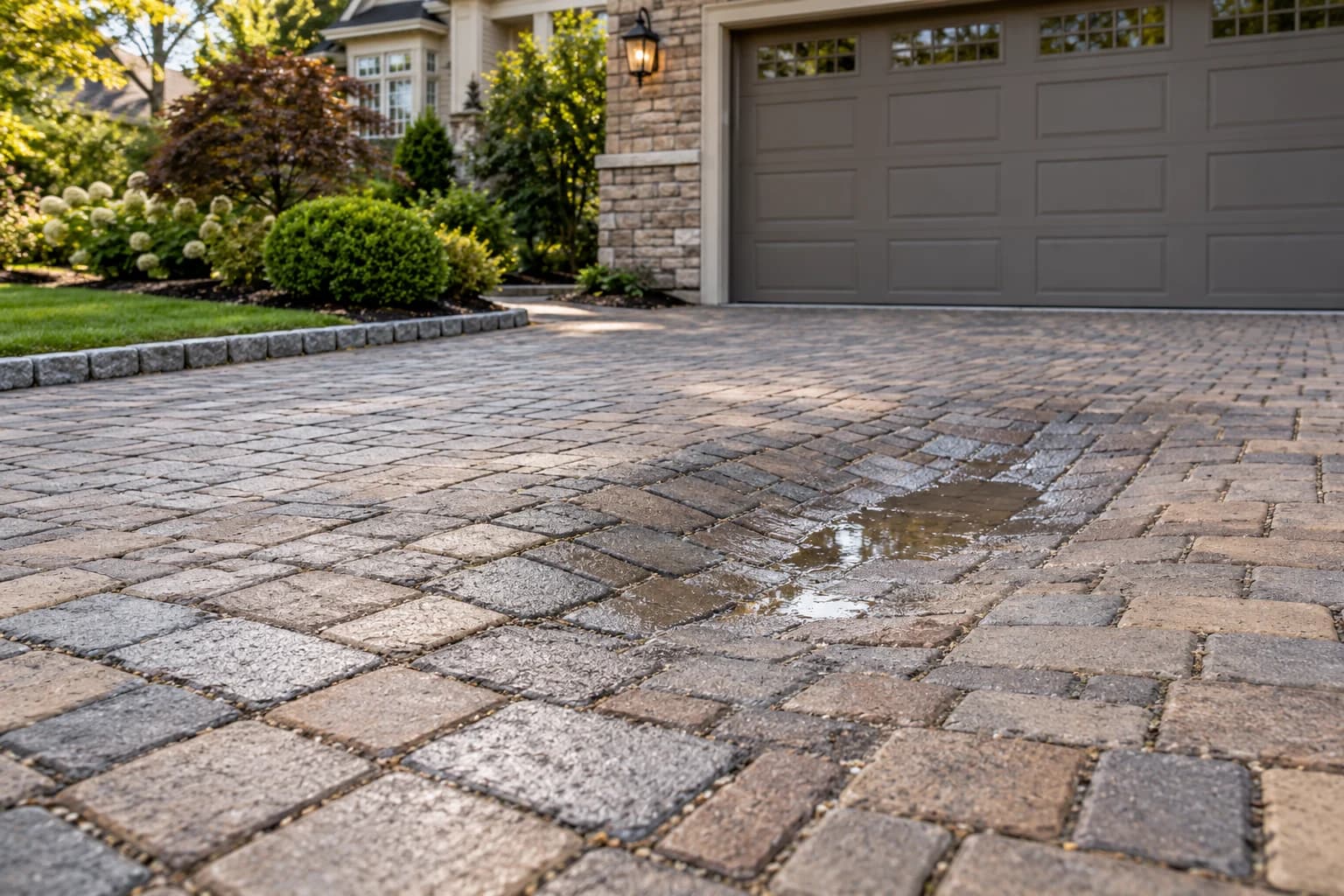
Illustration created for this guide.
Sunken Driveway Pavers in NJ: What a Lasting Repair Should Address
A low patch in a paver driveway can collect water, interrupt the finished appearance, and create an uneven transition near a garage or walkway. Lifting and resetting pavers may be an appropriate repair, but the work needs to account for why that area settled.
For New Jersey homeowners, the useful comparison is between a surface adjustment and a repair that investigates the supporting layers and drainage. Simply adding material until the top looks level may leave the underlying condition unresolved.
Map the affected area first
Photograph the driveway from several angles and mark where water collects after rain. Note whether the depression follows vehicle wheel paths, sits near a trench or utility repair, appears beside an edge, or is concentrated near a downspout.
Also record when you first noticed the change and whether it is growing. A single low spot and broad movement across the driveway call for different questions. Photos of the entire driveway help a contractor see patterns that a close-up of one paver cannot show.
Look below the visible surface
A paver surface relies on supporting layers and edge restraint as well as the paving units themselves. When settlement appears, ask what the inspection can establish about those components and what will be checked when the area is opened.
The Concrete Masonry and Hardscapes Association's technical resources include installation and maintenance guidance for segmental paving systems. The homeowner's practical task is to ask which system is installed and how the proposed repair fits its construction rather than assuming all pavers have the same base arrangement.
Drainage and elevation should be considered together
The goal is not necessarily to make every surface perfectly level. A driveway needs an appropriate finished shape and water route for the property. Ask where the restored area will direct runoff and how it meets the garage, sidewalk, and adjacent lawn.
If a downspout discharges onto or beside the low area, include that detail in the inspection. Correcting the pavers while leaving the same concentrated water source may be an incomplete project. Our downspout drainage guide helps frame that part of the discussion.
What a lift-and-reset proposal should include
Ask how far beyond the visible depression the contractor expects to open the surface. The working area may need to extend beyond the lowest point so the repair can connect properly to surrounding elevations.
A clear scope should describe removal and storage of reusable pavers, assessment of the exposed layers, corrective preparation, resetting, joint treatment, and any edge-restraint work. It should also explain how broken or unavailable matching units are handled.
| Scope question | Why it matters |
|---|---|
| What area will be opened? | The cause may extend beyond the deepest point |
| Which layers are being corrected? | Resetting only the surface differs from base repair |
| What is the finished drainage plan? | Removing a puddle should not redirect water toward the house |
| Are edges secure? | Movement at a boundary may affect the surrounding pavement |
| Can existing pavers be reused? | Matching and replacement availability affect appearance |
| How is concealed work approved? | The full condition may become clear only after opening |
Localized repair or a larger driveway project?
A limited repair is worth considering if the defect is localized and the remaining driveway is sound. A broader project may be more appropriate where settlement affects large areas, drainage geometry is unsuitable, or previous repairs repeatedly fail.
Ask for an explanation tied to the observations. A contractor should distinguish functional corrections from optional appearance changes. If you also want a new border, wider parking area, or different material, price that work separately enough to understand the decision.
See Duraproof's driveway services for the starting point, and our walkway material guide if the driveway connects to an entrance project.
Keep a record after the repair
Take photos of the completed area and save the written scope. Observe runoff during a later rain and note any continuing movement. Ask what follow-up maintenance is appropriate for the installed joint material and paving system.
Avoid assuming that a sealer can correct a settlement problem. Surface treatments and structural preparation serve different purposes; the proposed work should make that distinction clear.
Frequently asked questions
Can settled pavers be reused?
Often they can be considered for reuse if they remain suitable. Condition, breakage during removal, and availability of matching replacements should be discussed in the estimate.
Will adding sand fix the depression?
The answer depends on which layer has moved and why. A surface adjustment does not automatically correct base or drainage problems.
Does one low spot mean replacing the whole driveway?
No. The extent and cause of movement determine whether a localized repair can be reliable. Ask for both the findings and the proposed limits of work.
How do I get a repair estimate?
Contact Duraproof with your town, whole-driveway photos, and rain photos of the low spot. We serve 10 New Jersey counties. Call (551) 430-2998 to discuss the scope.
Have a project in mind?
Tell Duraproof what needs fixing or what you want to improve. Start with the job and your contact details; we can work through the rest together.