
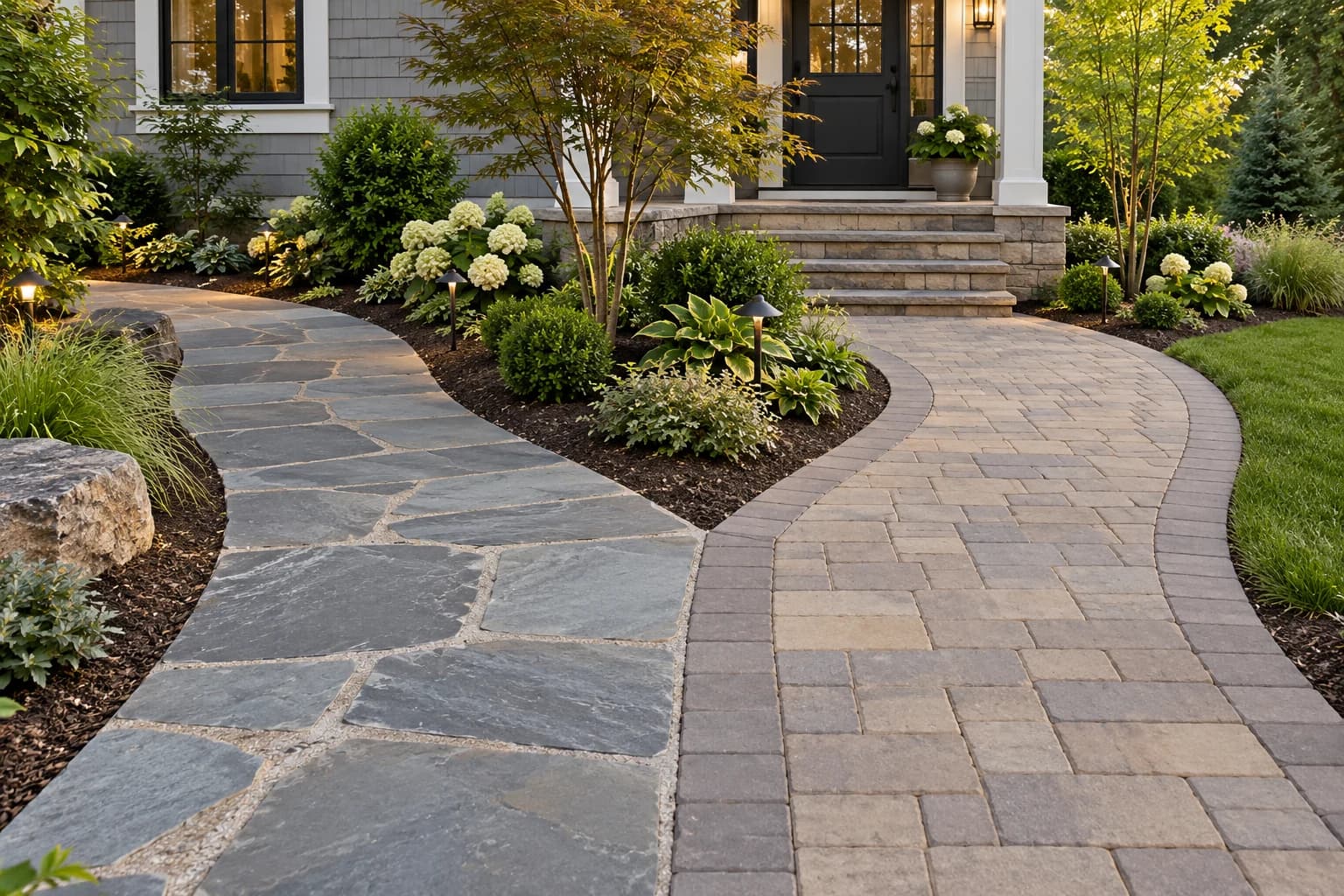
Illustration created for this guide.
Bluestone vs. Concrete Paver Walkways for New Jersey Homes
A walkway should look at home beside the house and make the everyday route to the door comfortable. Bluestone and concrete pavers can both create an attractive entrance, but choosing between them involves more than a color sample. Layout, surface texture, supporting construction, drainage, and future repairs all belong in the comparison.
For a New Jersey homeowner planning a front path, start with how the space is used. A short decorative garden route and the main entrance used by family, visitors, and delivery workers may need different priorities. The best material choice follows those needs rather than a trend alone.
Compare the appearance at the scale of the house
Bluestone offers natural variation in tone and texture. Concrete pavers offer a wide range of manufactured shapes, colors, and patterns. Samples help, but a small piece does not show how a long path, border, or curved landing will read against the siding and steps.
Ask to see completed work with similar proportions. Duraproof's project portfolio includes real masonry and walkway examples, which are more useful for that conversation than treating an illustrative design image as a completed customer project.
Layout can matter as much as material
Discuss the path width, turns, landing areas, and how it meets the driveway or sidewalk. Consider who uses it, what needs to pass along it, and where planting or lighting will sit. A beautiful material can still feel awkward if the route is too constrained or the connection to the front steps is poorly planned.
Ask the contractor to explain the finished elevations at both ends. Those connections should be resolved before choosing a decorative border. If the front steps also need work, coordinate the plan with our steps repair and rebuilding guide.
Surface finish and weather exposure
Compare the actual surface finish proposed, including how it feels and looks when wet. Shade, nearby trees, drainage, and maintenance can affect the condition of an entrance over time. Avoid accepting a blanket promise that one material is always slip-proof.
Ask about appropriate cleaning and winter maintenance for the specific product and assembly. If deicing products will be used, confirm manufacturer or supplier guidance rather than assuming the same treatment suits every stone or paver surface.
The base and installation method need to be specified
The finished material is only the visible part of the walkway. Ask what supporting construction is proposed and how it suits the site and chosen system. Installation methods can differ, so two estimates using the word “bluestone” may describe different assemblies.
For paver systems, ask about the supporting layers, edge restraint, and joints. For natural stone, ask how the selected installation method manages support and water. The Concrete Masonry and Hardscapes Association's technical resources are a useful reference for understanding that paving performance depends on more than the top surface.
Plan where rainwater will go
A walkway should connect to the surrounding drainage plan. Ask whether water will cross the path, collect near a landing, or be redirected toward the house. Nearby gutter outlets and changes in landscape grade should be considered before construction.
If there is already a puddle or settled area, document it. New finish material should not conceal an unresolved elevation problem. Read our guide to settled pavers for questions that also apply to an existing path.
| Decision | What to compare |
|---|---|
| Appearance | Color variation, pattern, border, and relationship to the house |
| Walking surface | Actual texture and suitability for the entrance's use |
| Construction | Proposed support, joints, and edge or transition details |
| Drainage | Finished elevations and runoff route |
| Repair | Access to individual units and matching replacement availability |
| Maintenance | Cleaning, joint care, and product-specific winter guidance |
Think about future access and repairs
Ask how a damaged or settled section would be repaired and whether matching material is likely to be available. Keep a record of the product or stone selection, installation details, and any leftover units supplied at completion.
If future underground work is planned near the path, mention it before construction. Coordinating projects can help avoid opening a newly completed walkway for a separate utility or drainage job.
Frequently asked questions
Is bluestone always more expensive than pavers?
The total depends on material selection, pattern, access, site preparation, and installation method. Compare complete written scopes rather than a material price alone.
Which walkway requires less maintenance?
Maintenance depends on the product, assembly, exposure, joints, and drainage. Ask for care instructions for the actual proposed materials.
Can I replace only the surface of my old path?
The existing support and drainage need assessment first. A new finish should not conceal movement, unsuitable elevations, or deteriorated construction.
Can Duraproof help plan the entrance?
Review our walkway installation service, then request a free estimate with photos, your town, and the route you want to improve. Call (551) 430-2998 to discuss the next step.
Have a project in mind?
Tell Duraproof what needs fixing or what you want to improve. Start with the job and your contact details; we can work through the rest together.