
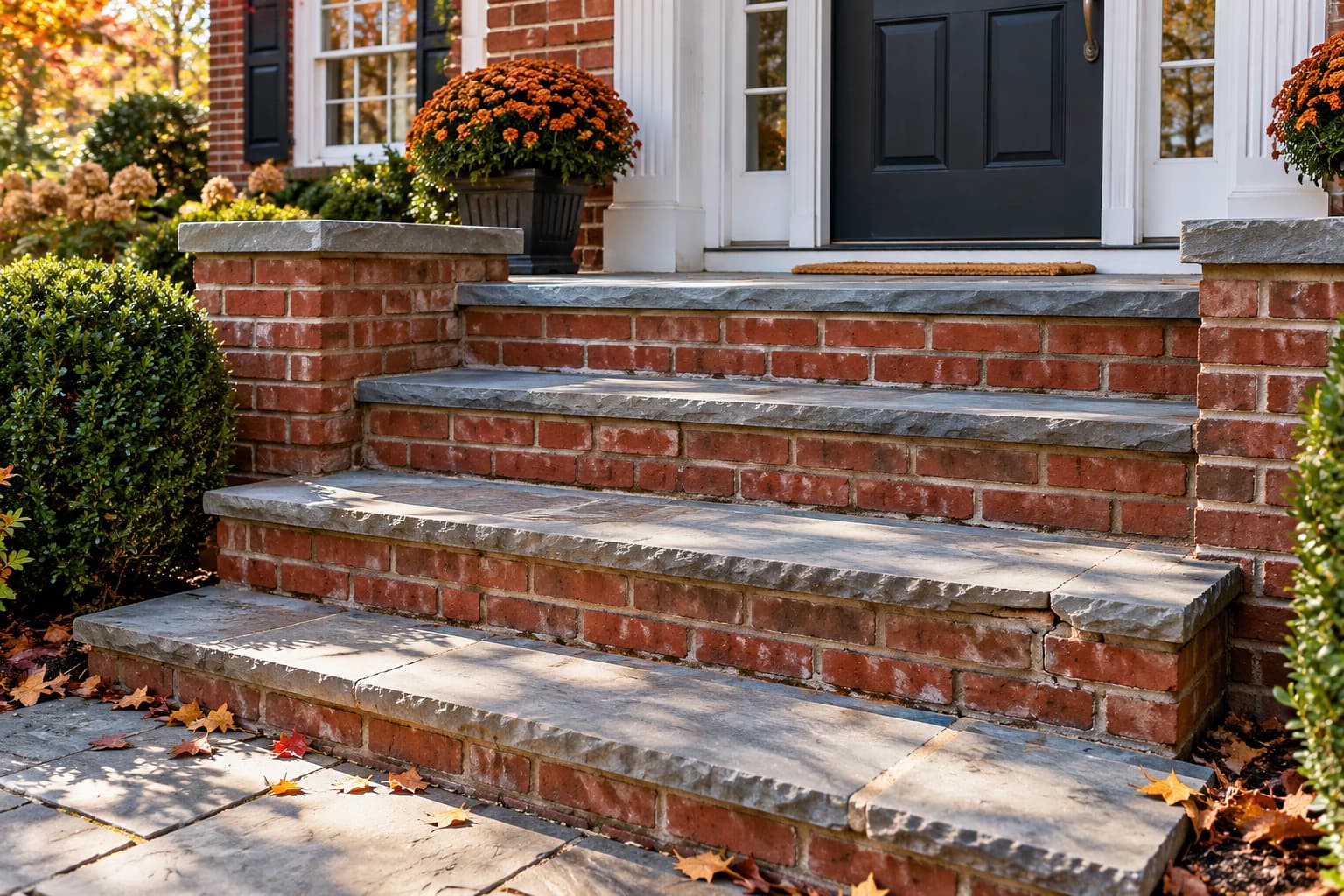
Illustration created for this guide.
Brick Front Steps in NJ: When to Repair and When to Rebuild
Front steps need to do more than improve a home's entrance. They need to provide a reliable walking surface and connect properly to the landing, path, and surrounding grade. When brick joints open or a tread loosens, the first decision is whether the problem is a localized finish defect or a sign of movement in the structure beneath it.
New Jersey homeowners often notice masonry changes after winter: chipped edges, missing mortar, or a gap that looks larger than it did in the fall. Those observations are useful, but a repair recommendation should be based on the steps' actual construction and condition.
Distinguish mortar wear from movement
Localized deteriorated mortar can sometimes be addressed with an appropriate repointing scope. Repointing is different from correcting a moving stair assembly. If the underlying structure is shifting, a fresh joint may crack again because the original cause remains.
Look for changes in alignment, separation from the house, uneven treads, or a landing that no longer drains as expected. Photograph the whole entrance as well as the damaged joints. An isolated close-up cannot show how the stair connects to the surrounding surfaces.
Loose treads deserve prompt attention
A tread that rocks, shifts, or has a broken edge is a practical access concern. Avoid treating a cosmetic patch as proof that the walking surface is secure. Ask the contractor to assess both the tread and the support beneath it.
If access needs to be restricted while the steps are assessed, plan an alternative entrance. Let the contractor know about mobility needs, frequent deliveries, or any other condition affecting safe access during the project. Those details belong in the work plan before demolition begins.
Drainage can affect the scope
Water collecting on a landing, entering open joints, or arriving from a downspout can contribute to repeated maintenance problems. The inspection should consider the source and route of that water rather than focusing only on the visible damaged face.
Ask how the completed treads and landing will shed water and connect to adjacent paving. If the nearby gutter discharge runs across the entrance, coordinate that correction with the masonry work. Our downspout drainage guide covers the roof-water side of that conversation.
Repair options should name the actual work
| Potential scope | What to establish first |
|---|---|
| Repointing | Is the underlying masonry stable? |
| Replacing damaged brick | How extensive is deterioration beyond the visible unit? |
| Resetting or replacing a tread | Is the support beneath it sound? |
| Rebuilding a landing or stair | What movement or deterioration requires reconstruction? |
| Drainage correction | Where does water arrive and where should it leave? |
Ask whether the contractor is repairing a finish, a connection, or the supporting assembly. These scopes can look similar in a brief quote but involve different work and expectations.
When rebuilding may be appropriate
A broader rebuild deserves discussion when movement is substantial, deterioration extends through the assembly, or the existing layout cannot be repaired satisfactorily. The contractor should document why patching would not address the condition.
Rebuilding is also an opportunity to review the stair and landing arrangement, adjoining walkway, railing needs, and current local requirements. Do not assume that replacing the visible material means every existing dimension can automatically be copied. Confirm the proposed layout and approvals before construction.
Choosing materials without losing the practical details
Brick, concrete, natural stone, and stone veneers offer different appearances and construction approaches. Discuss tread finish, edge details, maintenance, and how materials meet the house and path. A small sample is helpful, but the estimate should explain the whole assembly behind the finished surface.
For an entrance project that includes the path, read our bluestone versus paver walkway guide. Coordinating the steps and walkway can avoid creating an awkward transition between two separately designed projects.
Frequently asked questions
Can cracked mortar simply be filled?
That depends on the joint condition and whether the structure is stable. A surface fill does not correct movement or replace deteriorated material deeper in the joint.
Does one broken brick require rebuilding the steps?
Not automatically. The inspection should establish whether damage is localized and whether the surrounding assembly can support a reliable repair.
Can new stone cover existing steps?
The existing structure, drainage, dimensions, and material compatibility need evaluation first. A new finish should not conceal unresolved movement or deterioration.
Can Duraproof provide repair and rebuild options?
Tell us what has changed and send whole-entrance photos. Review our front steps and masonry service, request a free estimate, or call (551) 430-2998. Duraproof serves 10 counties in New Jersey.
Have a project in mind?
Tell Duraproof what needs fixing or what you want to improve. Start with the job and your contact details; we can work through the rest together.