
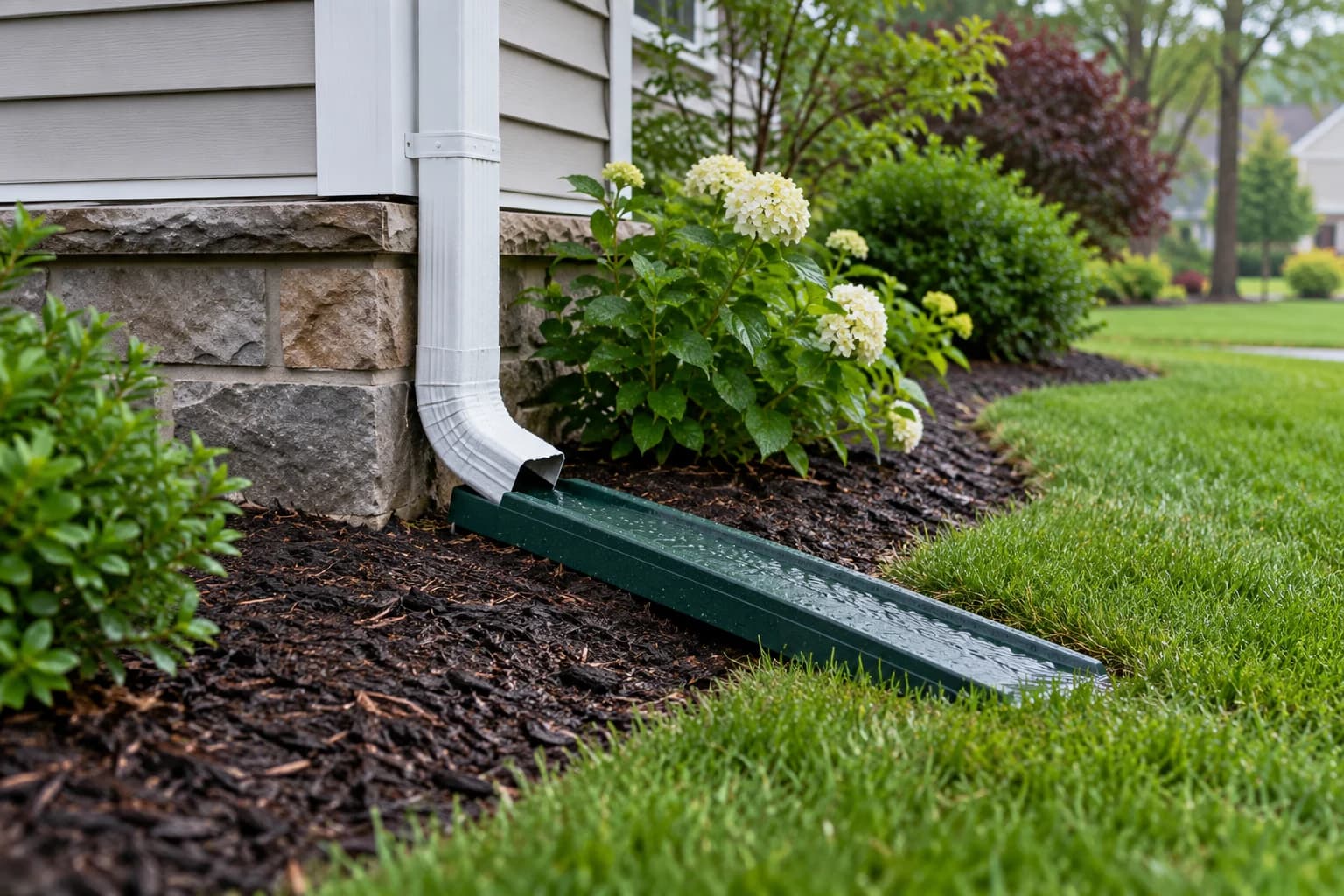
Illustration created for this guide.
Downspout Drainage in NJ: Where Should Roof Water Go?
A gutter system has not finished its job when water reaches the bottom of the downspout. The discharge point matters just as much as the roof-edge collection. Water released beside a foundation, onto an entry path, or into a blocked buried pipe can create a new problem downstream from perfectly clean gutters.
For New Jersey homes on tight lots or sloping properties, there is rarely one universal extension length or connection detail that suits every house. The useful question is where runoff can go appropriately on this property, under the applicable local requirements, without creating a problem for the building or neighboring land.
Follow the whole drainage path
Start at the roof section feeding the gutter. Follow the run to the outlet, down the pipe, and to the final discharge. If the pipe enters the ground, establish where it connects and where it ultimately releases water. An underground opening beside the house is not proof that the system is functioning.
Take photographs during rain from safe ground-level positions. Note whether water backs up at the bottom elbow, disappears into a pipe and reappears nearby, or collects along the foundation. These observations help separate gutter restrictions from ground-level drainage limitations.
Surface extensions: simple, but still site-dependent
A surface extension may provide a visible route away from the immediate foundation area. Its usefulness depends on the ground slope, available space, discharge surface, and whether it creates an obstruction.
EPA's downspout redirection resource discusses redirecting roof runoff toward appropriate landscaped areas. The right arrangement still needs to account for the individual lot. Do not assume that sending water toward a sidewalk, driveway, or neighboring property is acceptable simply because it leaves your foundation.
Underground connections need a known destination
Buried drainage can be attractive because it removes a visible pipe across the yard. It also makes the flow path harder to inspect. Before connecting a new downspout, ask whether the existing line has been checked, what it serves, and where the outlet is located.
A buried line should not be treated as a mystery disposal point. If its condition is uncertain, the estimate should distinguish gutter work from investigating or replacing the underground system. Combining those assumptions into one vague “connect drainage” item makes later disputes more likely.
Grade, paving, and landscaping all matter
Even a well-positioned outlet can perform poorly if the receiving surface directs water back toward the house. Settled paving, low landscape beds, and changes made during previous projects may influence the path.
Consider nearby steps and walkways. A discharge point that keeps water away from the foundation but crosses the main entry route may create a different maintenance or winter-weather concern. If paving needs correction, coordinate the discussion with walkway work or driveway repairs rather than evaluating the pipe in isolation.
Questions to include in a drainage estimate
| Question | What a clear answer should establish |
|---|---|
| Where does each downspout terminate? | A visible and understood discharge route |
| Is an existing buried pipe being reused? | Its known condition and destination |
| Is excavation included? | The extent of work and restoration |
| How are walkways crossed or avoided? | Access and surface-water consequences |
| Are local approvals needed? | Who will confirm requirements and obtain approvals |
| What remains outside the scope? | Separate grading, foundation, or drainage work |
Ask for the proposed route to be shown on photos or a simple site sketch. You should be able to understand where the water will go before the installation begins.
When gutter replacement alone is unlikely to solve it
If water enters the basement while gutters are carrying runoff normally, the problem may involve ground conditions or the foundation rather than gutter capacity. The inspection should acknowledge that limit. No responsible gutter estimate can guarantee that replacing a channel will solve every source of basement moisture.
Similarly, a larger gutter does not clear a restricted underground pipe. Use our gutter sizing guide to separate collection capacity from outlet and discharge questions.
Frequently asked questions
How far should a downspout extend?
The appropriate arrangement depends on slope, soil, space, discharge conditions, and local requirements. Ask for a site-specific plan rather than relying on a single distance for every home.
Can a downspout connect to any existing pipe?
The connection should be identified and confirmed appropriate before reuse. A pipe's presence does not establish its purpose, condition, or approved destination.
Should drainage work happen with new gutters?
Coordinating the projects can help, provided both scopes are clearly described. Ask which work the gutter contractor performs and which work needs a separate specialist.
Can Duraproof look at the roof-water side?
Yes. Request a gutter estimate with the town, photos of the downspout bases, and a description of what happens during rain. Duraproof serves 10 New Jersey counties. Call (551) 430-2998 to discuss the property.
Have a project in mind?
Tell Duraproof what needs fixing or what you want to improve. Start with the job and your contact details; we can work through the rest together.