
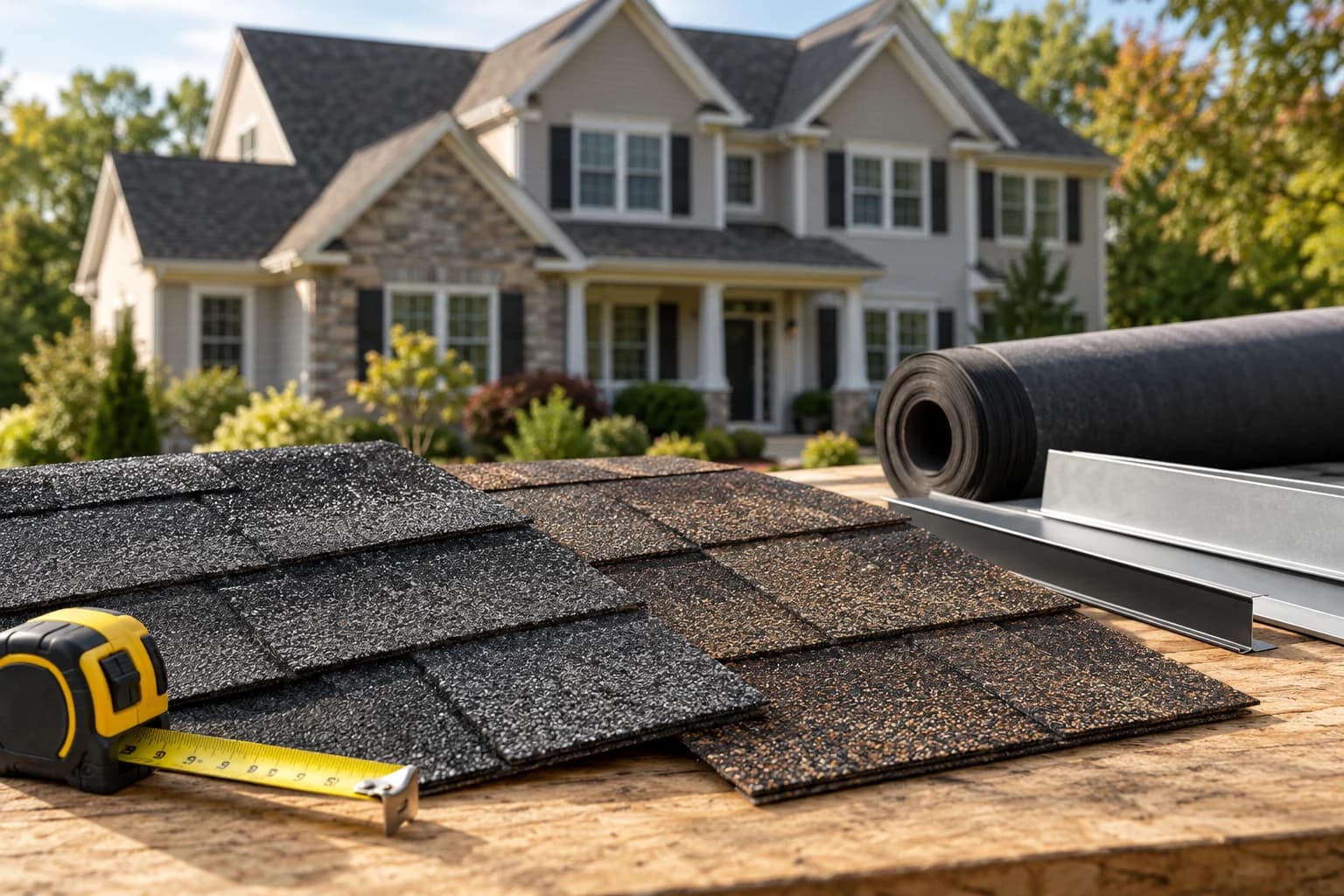
Illustration created for this guide.
What Should a Roof Replacement Estimate Include in New Jersey?
Two roof replacement estimates can list the same shingle color and still describe very different projects. One may include full tear-off and new flashing details. Another may leave important connections unspecified or treat damaged decking as an undefined extra.
The best comparison begins with a common scope. Before focusing on the final number, identify which parts of the roofing system each contractor will replace, inspect, retain, or exclude. This guide gives New Jersey homeowners a practical checklist for that conversation without pretending that every house has the same price.
1. The roof area and removal scope
The proposal should identify which roof sections are included. Attached garages, porch roofs, additions, and low-slope areas should be named where applicable. Ask whether the estimate includes removing the existing roofing, how existing layers affect the work, and what happens to old materials.
A description such as “new roof” is too broad to settle these questions. If a low-slope addition needs a different assembly from the main shingle roof, it should have its own material and installation description.
2. Decking inspection and concealed damage
Some decking conditions cannot be fully evaluated until roofing is removed. A clear estimate explains the inspection process and how additional decking work is priced. Ask what approval is required before extra work proceeds and what documentation you will receive.
Clarify whether repairs are priced by sheet, area, or another defined unit, and what labor and disposal are included. The point is not to predict every concealed condition; it is to agree on a fair process before the roof is open.
3. Underlayment and water-sensitive details
Ask which underlayment and leak-protection materials are included and where they will be installed. The proposal should account for valleys, eaves, penetrations, transitions, and other vulnerable connections appropriate to your roof.
Product names alone do not describe the whole installation. Ask how these materials connect to flashing and adjoining walls. The contractor should follow the selected system's requirements and confirm applicable local requirements rather than relying on a generic checklist for every building.
4. Flashing, pipe boots, and chimney connections
List roof-to-wall connections, chimneys, skylights, pipes, and other penetrations. For each, ask whether components are replaced, rebuilt, or retained after inspection. If chimney masonry or skylight replacement is excluded, that should be visible in the scope.
Our guide to chimney flashing leaks explains why installing new shingles around an unresolved connection can leave a water problem behind.
5. Ventilation and attic observations
Roof work is a useful time to discuss visible attic moisture and the existing intake and exhaust arrangement. Ask what the roofer observed and whether any ventilation changes are included. A ridge vent listed in isolation does not explain whether the whole airflow path has been considered.
If insulation, air sealing, or bathroom exhaust corrections fall outside the roofing work, request that distinction. Our attic condensation guide covers questions that help separate those issues.
6. Materials, appearance, and warranties
The estimate should name the proposed shingle or membrane product, color, and relevant accessories. Ask to see physical samples when possible, since small screen images can make colors difficult to compare.
Separate the manufacturer's product coverage from the contractor's workmanship coverage. Ask who registers any warranty, what paperwork you receive, which exclusions apply, and whom to contact if a problem appears. Do not assume that a long product warranty means every repair expense is covered.
7. Property protection, cleanup, and access
Discuss landscaping, siding, windows, outdoor furniture, parked vehicles, and material staging. Ask where the dumpster will sit, whether the driveway needs protection, and how nails and debris will be collected.
Homes with tight access in Hudson or Essex County may need different staging arrangements from properties with larger driveways in Morris or Somerset County. Those logistics should be reflected in the actual project plan rather than discovered on installation day.
A simple estimate comparison worksheet
| Item | Question to resolve |
|---|---|
| Roof sections | Are the garage, porch, and additions included? |
| Removal | What existing materials and layers are removed? |
| Decking | How are concealed repairs documented and priced? |
| Flashing | Which details are replaced or retained? |
| Ventilation | What observations and changes are included? |
| Cleanup | What property protection and debris removal are provided? |
| Warranty | What covers materials and what covers workmanship? |
| Changes | How are additional work and schedule changes approved? |
Frequently asked questions
Why are roof replacement prices different?
Different roof geometry, access, existing layers, materials, and concealed conditions affect the scope. Even for the same property, competing proposals may include different work. Compare those details before interpreting a price gap.
Should the estimate promise an exact completion date?
A proposed schedule is useful, along with the conditions that can change it. Ask how weather, material delivery, and unexpected damage will be communicated.
How do I check a contractor's credentials?
Use the current New Jersey Division of Consumer Affairs license and registration verification service and request current insurance information. Confirm the business identity on the written proposal rather than relying only on advertising.
Can Duraproof provide a written scope?
Contact Duraproof with your property location and project goals. You can also review our New Jersey roof replacement service or call (551) 430-2998 to discuss an estimate.
Have a project in mind?
Tell Duraproof what needs fixing or what you want to improve. Start with the job and your contact details; we can work through the rest together.