
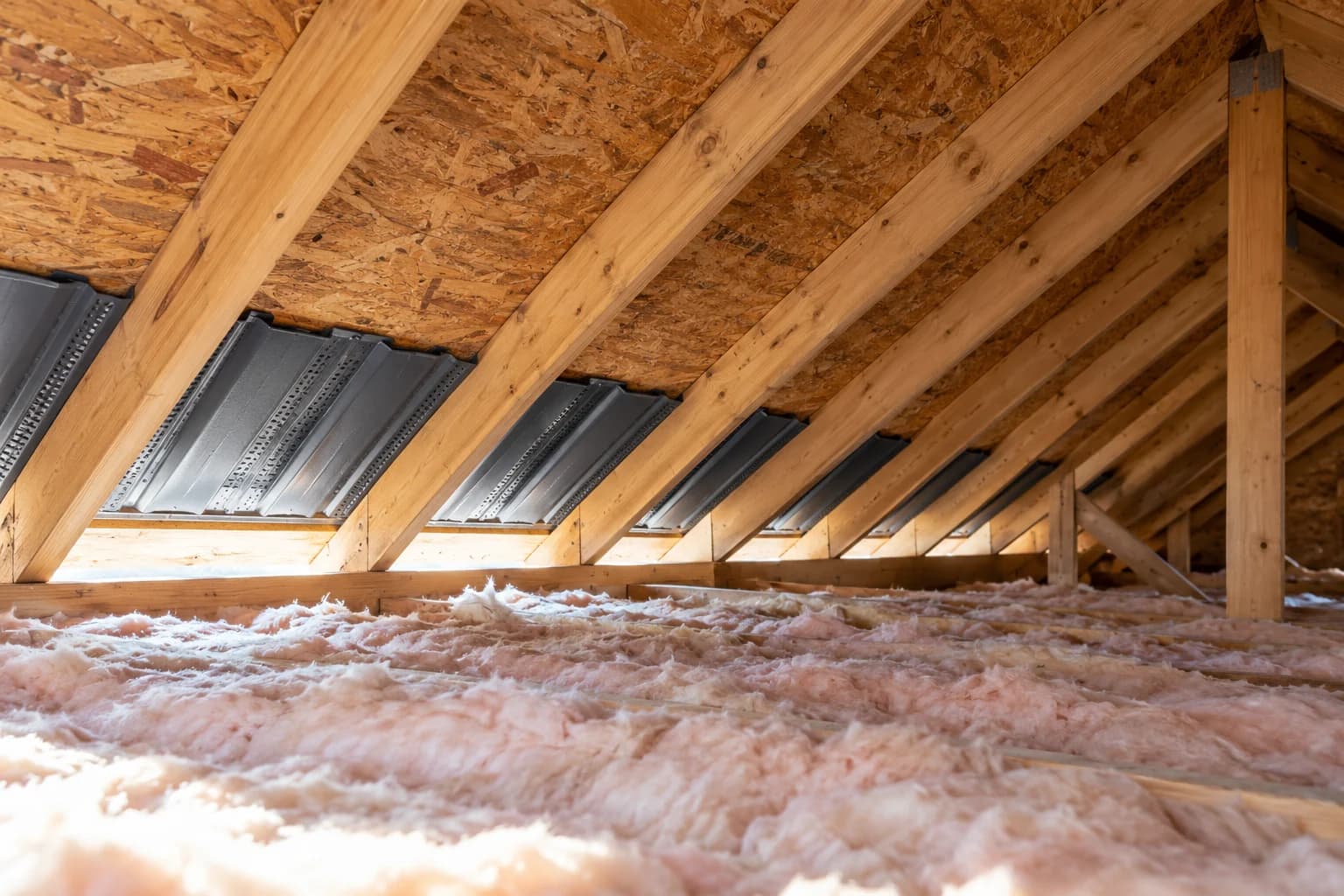
Illustration created for this guide.
Attic Condensation or a Roof Leak? What NJ Homeowners Should Check
Moisture in the attic does not always begin outside the roof. Warm, humid indoor air can reach colder roof surfaces and create condensation. A roof leak can produce some of the same visible signs. Before choosing a repair, the inspection needs to distinguish these possibilities and consider whether both are present.
This matters during New Jersey's colder months, when an attic can be much colder than the rooms below it. Homeowners in Sussex, Morris, Bergen, and neighboring counties may notice damp nails, darkened wood, insulation changes, or moisture that seems disconnected from the latest rainstorm.
Compare the pattern with the weather
A useful starting point is a simple observation log. Write down when moisture appears, whether rain or snow occurred, and whether the affected area is concentrated near a penetration or spread across the attic. Photographs taken from the same safe position can help compare changes.
GAF's roof condensation guidance notes that condensation and roof leaks can resemble one another, and that weather timing and distribution provide useful clues. Those clues guide an inspection; they do not establish the cause on their own.
Three connected topics: air sealing, insulation, ventilation
These subjects are often discussed separately, but they affect the same attic. Air sealing addresses paths by which indoor air reaches the attic. Insulation manages heat transfer. Ventilation provides an airflow arrangement appropriate to the roof assembly.
ENERGY STAR's attic ventilation guide emphasizes the relationship between ventilation, insulation, and air sealing and warns against blocking soffit airflow. Adding more vents without understanding the existing assembly is not a substitute for investigating moisture sources.
For the homeowner, the practical question is whether the recommendation explains all three topics or simply sells one component.
Observations worth sharing with a contractor
- Dampness appears during cold weather even without recent rain.
- Moisture is visible across a broad area rather than one isolated point.
- A stain repeatedly returns near a chimney, skylight, or wall connection.
- Bathroom or other exhaust ducting appears disconnected or terminates in the attic.
- Stored items or insulation appear to obstruct visible eave pathways.
- Previous roof or insulation work changed when the problem appeared.
Avoid disturbing electrical wiring or walking on unsupported attic surfaces to investigate. Photos from a safe access point and an accurate history are enough to start the discussion.
What the roof inspection should include
The contractor should look for exterior entry points as well as interior moisture patterns. Flashings, damaged roofing, and penetrations remain relevant even when condensation is suspected. Visible decking condition and the intake and exhaust layout should be documented.
Ask whether the proposed correction addresses the roof, attic airflow, indoor air leakage, or a combination. If another trade needs to correct exhaust ducting or insulation, the scope should make that handoff clear. A new roof should not be represented as an automatic cure for every source of attic moisture.
Why ventilation changes need a plan
Different roof forms and assemblies call for different ventilation decisions. A house with a finished attic is not evaluated in exactly the same way as a conventional open attic. Existing insulation placement, available intake space, roof geometry, and manufacturer requirements all matter.
Ask the contractor to identify where air enters, where it exits, and which existing obstructions or defects need attention. The answer should connect the proposed work to your house rather than rely on the appearance of a new ridge vent.
For broader roofing decisions, see repair versus replacement and our roof replacement estimate checklist.
Document the result after repairs
Keep the original photos, written findings, and completed scope. Ask what conditions should be monitored afterward and when the attic should be checked again. If moisture returns, that record helps distinguish incomplete correction from a new issue.
Avoid painting over stains or covering damp areas before the source has been evaluated and the materials have been assessed. Cosmetic changes can hide information the next inspection needs.
Frequently asked questions
Can condensation look like a roof leak?
Yes. Damp wood, staining, and wet insulation can have different causes. An inspection should combine moisture patterns, weather history, and roof observations.
Will installing a ridge vent solve the problem?
It depends on the existing assembly and moisture source. The recommendation should explain intake, exhaust, insulation, air leakage, and any separate exhaust-duct issue.
Should I replace the roof because the attic is damp?
Roof replacement may be appropriate if roofing or decking conditions justify it, but attic dampness alone does not describe the whole scope. Establish the cause first.
Who can inspect the roofing side of the problem?
Duraproof can assess roof repair needs and discuss roofing and ventilation observations. Request an estimate with photos and the timing of the moisture, or call (551) 430-2998.
Have a project in mind?
Tell Duraproof what needs fixing or what you want to improve. Start with the job and your contact details; we can work through the rest together.