
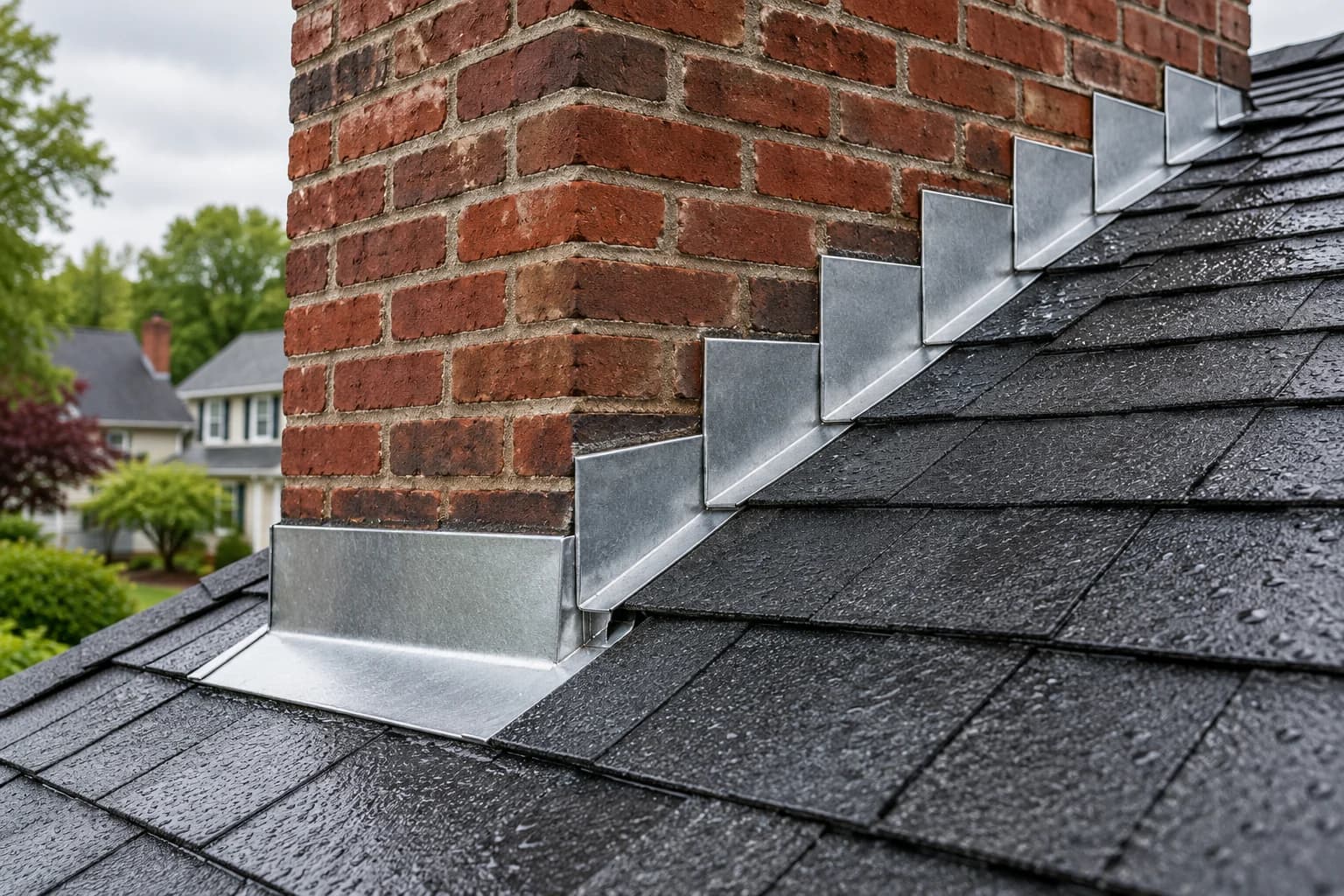
Illustration created for this guide.
Roof Leaking Around the Chimney? A New Jersey Homeowner's Guide
A ceiling stain near a chimney does not automatically mean the entire roof needs replacement. The leak may begin at the metal connection between the roof and masonry, travel along framing, and appear several feet from where water entered. The useful first step is identifying that entry point before choosing a repair.
For homeowners in Rutherford, Clifton, Hackensack, and surrounding Bergen and Passaic County communities, a chimney leak deserves a coordinated look at both roofing and masonry. Replacing shingles alone will not resolve an opening higher on the chimney. Repointing bricks alone will not rebuild poorly integrated roof flashing.
What chimney flashing actually does
Flashing directs runoff across joints where different building surfaces meet. At a chimney, several pieces work together: an apron along the downhill face, step flashing along the sloped sides, and counterflashing that protects the upper edges. The uphill side needs a detail that moves water around the chimney rather than trapping it.
GAF's explanation of roof flashing describes why roof intersections and penetrations need these water-shedding connections. The exact assembly should follow the roofing system and site conditions; one universal bead of caulk is not a complete flashing design.
Clues that help narrow down the source
Record when the moisture appears. A leak during wind-driven rain may behave differently from a stain that develops after snow melts. Note whether the fireplace is in use, whether the attic is accessible, and whether earlier repairs temporarily changed the problem.
Useful photos include the indoor stain, the whole chimney from ground level, and any visible damaged metal. Avoid climbing onto a wet or steep roof to collect close-ups. A contractor can inspect the inaccessible connections with appropriate equipment.
| Observation | What should be investigated |
|---|---|
| Water appears beside the chimney during rain | Flashing joints, roofing integration, and masonry above |
| Staining returns after repeated surface sealing | Concealed laps, deteriorated metal, and the original entry point |
| Cracked mortar or damaged brick is visible | Masonry condition as well as roof flashing |
| Moisture is spread across the attic | Condensation and ventilation, alongside potential leaks |
These are inspection directions, not a remote diagnosis. More than one defect can be present on the same chimney.
What a proper inspection should cover
Ask the roofer to explain how the shingles overlap the flashing, where counterflashing terminates, and whether the uphill connection drains freely. The evaluation should also look for soft decking, previous patch layers, loose fasteners, and deteriorated shingles next to the chimney.
The chimney crown, cap, brick faces, and mortar joints belong in the same conversation. If a masonry defect is outside the roofing scope, the estimate should identify it rather than quietly excluding the likely source. Duraproof provides both roof repair in New Jersey and chimney repair services, which makes a combined assessment useful when the cause crosses trades.
Repairing flashing versus replacing surrounding roofing
A localized flashing repair can make sense when the neighboring roof materials are sound and the defective connection can be rebuilt correctly. An estimate should state how much roofing must be removed to access the detail and how that area will be restored.
Broader work may be justified if the surrounding shingles are brittle, the decking has deteriorated, or several roof sections have related failures. Ask for photographs and a clear explanation of why a limited repair would or would not work. The decision should reflect the condition of the assembly rather than the size of the visible ceiling stain.
For a wider comparison, read our guide to roof repair versus replacement.
What should appear in the written estimate?
- The suspected water-entry point and inspection findings.
- Removal and replacement of the necessary shingles and flashing components.
- Treatment of concealed decking damage, including how additional work is priced.
- Any separate chimney crown, cap, or mortar work.
- Cleanup, access arrangements, and the repair warranty's actual coverage.
Ask whether the quote describes a temporary weatherproofing measure or a permanent repair. Both can be useful in the right circumstances, but the owner should know which one is being purchased.
Frequently asked questions
Can caulking around the chimney stop the leak?
It may slow some openings temporarily. If the flashing laps, metal, or masonry connection are defective, the underlying detail still needs inspection. Repeatedly covering the area can make the original source harder to locate.
Does chimney flashing get replaced with a new roof?
The estimate should explicitly explain what happens to existing flashing. Do not assume that a roof replacement automatically includes rebuilding every chimney connection or repairing damaged masonry.
Can the leak be coming from somewhere else?
Yes. Water can move before it becomes visible indoors. Roof valleys, nearby penetrations, masonry, and attic moisture can produce overlapping symptoms, which is why tracing the source matters.
What information should I send first?
Share the job description, your name, a phone number or email, and the town. The property address and photos are helpful when available. You can request a free estimate or call Duraproof at (551) 430-2998 to discuss the next inspection step.
Have a project in mind?
Tell Duraproof what needs fixing or what you want to improve. Start with the job and your contact details; we can work through the rest together.