
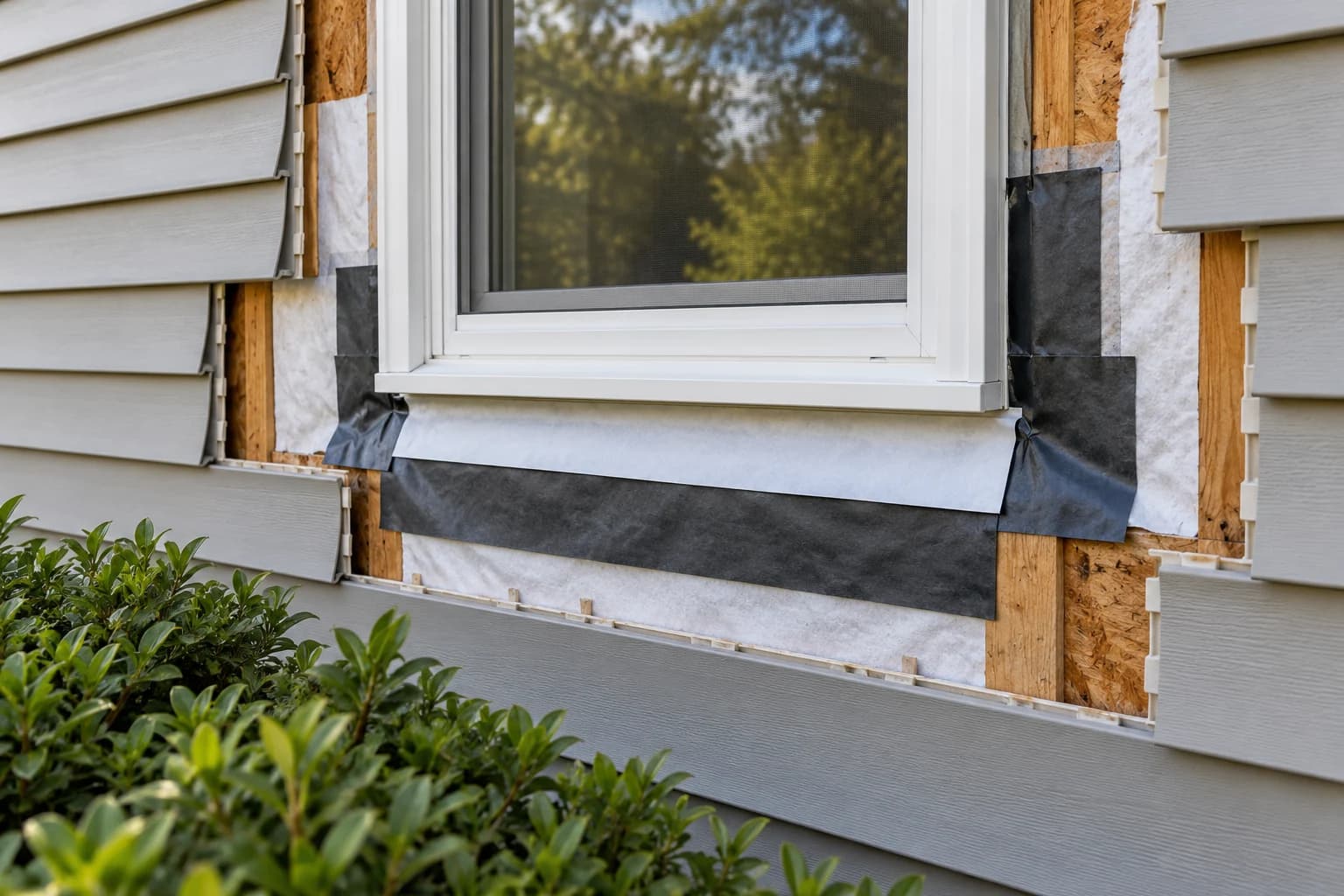
Illustration created for this guide.
Water Behind Siding: Window Flashing Questions for NJ Homeowners
An indoor stain near a window can lead homeowners to blame the window immediately. Sometimes the entry point is at the window assembly. In other cases, water begins higher on the wall, at a roof connection, or behind the siding and travels before appearing indoors.
The most useful repair starts with a plan to trace that path. Replacing a visible panel or sealing the nearest joint may change the symptom without resolving the cause. A careful inspection should consider the cladding, the underlying drainage layer, and the window or door connections together.
Siding is part of a wall system
The exterior panels provide a visible finish, but they are not the only water-management component. The wall behind them includes layers and connections intended to control water that gets beyond the outer surface.
CertainTeed's vinyl siding installation guidance states that vinyl siding is not a watertight material and calls for a weather-resistant barrier and flashing around openings. That distinction explains why a repair may need to reach behind a panel rather than focus only on the exposed face.
Keep a useful leak history
Write down which room is affected, the stain's location relative to the window, and whether the problem occurs in ordinary rain or only when wind comes from a particular direction. Include any roof, window, siding, or trim work performed before the leak began.
Photos of the interior and exterior help connect those observations. A whole-wall view shows roof intersections and upper openings that a close-up of the stain cannot. If possible, show the window above or beside the affected area as well as the one nearest the indoor damage.
What an investigation may involve
A contractor may need to inspect trim joints, window head and sill details, roof-to-wall connections, and the condition of accessible siding. In some cases, limited removal is needed to see concealed layers and damage. Ask what the investigation includes before authorizing a larger replacement scope.
The proposal should distinguish an inspection opening from a final repair. It should describe how the area will be temporarily protected if additional work is needed and how the findings will be documented. An owner should not have to guess what happens after siding is removed.
Why sealant alone may be incomplete
Sealant has appropriate uses, but it cannot substitute for every missing or incorrectly integrated flashing detail. Ask whether a proposed application follows the product requirements and whether it would obstruct an intended drainage path.
The key question is where the water goes after the repair. A useful explanation should follow water from the exposed surface across the relevant layers and away from the opening. It should not stop at “we will seal around the window.”
If the area is also wavy or loose, our vinyl siding repair guide covers the separate movement and attachment questions.
Repair scope: separate finish work from concealed work
| Scope item | What to clarify |
|---|---|
| Investigation | Which area will be opened and photographed? |
| Weather barrier | How will existing and new layers connect? |
| Flashing | Which window, door, or roof-wall details are corrected? |
| Damaged materials | What happens if sheathing or framing needs repair? |
| Exterior finish | How are siding and trim restored or matched? |
| Interior finish | Is stain or drywall repair included or separate? |
This distinction helps homeowners compare proposals that otherwise look similar. One estimate may address the concealed cause while another only restores the visible exterior.
Coordinate the trades when the source crosses boundaries
A leak near a roof-to-wall connection may require roofing work and siding access. A damaged window component may need a window specialist. The estimate should identify those interfaces and who is responsible for each part.
Duraproof provides siding work and roof repairs. When the suspected source involves both, describe the full history so the inspection can consider the connected details rather than treating each surface as an unrelated job.
Frequently asked questions
Does a stain under a window prove the window is defective?
No. The stain is an observation point. Water can travel from a different part of the wall or roof connection before it becomes visible.
Do all siding leaks require replacing an entire wall?
No. The extent of concealed damage, accessibility, product condition, and ability to rebuild the affected layers determine the scope. A limited opening may help establish that scope.
Can new siding go over an unresolved leak?
The moisture problem should be investigated before the new finish conceals it. Ask the contractor how the cause will be documented and corrected.
How do I arrange an assessment?
Contact Duraproof with the property town, weather pattern, indoor photos, and a whole-wall exterior view. We serve the 10 listed New Jersey counties. Call (551) 430-2998 to discuss the next step.
Have a project in mind?
Tell Duraproof what needs fixing or what you want to improve. Start with the job and your contact details; we can work through the rest together.